




Supercharge Your Back: The Trick to Proper Lat Training

Want to build bigger, wider lats? When performing pulldowns, kick what most people consider "good form" to the curb.
The stretch of a full range of motion pulldown feels good, but those feels could be coming at the cost of your lats.
If you’re trying to stimulate lat gains, it’s better if the shoulder DOESN'T fully elevate.


By elevate, we mean that feeling when you’re reaching for something and trying to eek out an extra couple inches, where the shoulder comes up or forward.
More isn’t *always* better. If you’re trying to isolate a specific muscle, a reduced range of motion can be key.
The lat works hardest when driving the elbow downward toward the hip. However, when the shoulder elevates and the scapula (shoulder blade) rises upward, additional muscles assist to pull them back down before the lat can fully engage.

See everything around the shoulder and shoulder blade not labeled lats? For this exercise, we want them chilling, with all the load directed against the lats.
While a longer pull might be more work, it isn’t necessarily more load on the lats specifically.
Instead, limit the height of the pull to the greatest stretch you can achieve without the shoulder “floating” upward.
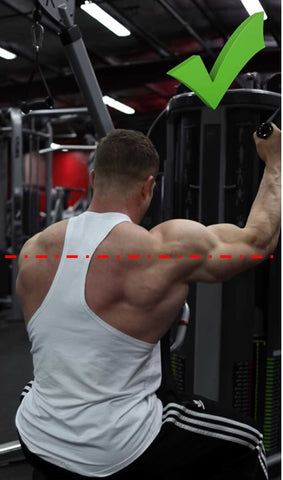
That's it. That's the "top" of the range of motion, strange as it may seem.

Call it a Partial if you want. Call it bad form. But to maximally target the lats --

The shortened range of motion will not only better emphasize the lats, but it will also allow you to hit them with heavier weight, too.
So keep that shoulder locked down and watch your wings grow. 👊
Also in News

How To: Target Back Muscle Growth
Most lifters don't give much thought to what grip they use on back day — but it's quietly influencing which muscles you're actually hitting.

The Rest Trick That Boosts Muscle Gains
One side gets a quality set. The other gets leftovers. Find out why most lifters do unilateral training wrong—and the simple rest trick that boosts muscle growth.

14 Essential Tips for Unstoppable Muscle
A handy check list to make this year your strongest, most muscular, leanest year ever. Bookmark this one, it's the 14 Commandments of Fitness.